

You’re reading the Your News Biz newsletter. My goal is to help digital media entrepreneurs and small businesses find viable business models.
Open door, closed mind
A big mistake I made as a newspaper publisher was my open-door policy. The mistake wasn’t the open door. It was the closed mind.
I prided myself on having an open door. But when any of the 30 employees came through the door — to ask about a company policy, to make a suggestion, to request we spend money on something — I often had a ready answer: We’ve tried that, and it didn’t work; it’s not in the budget; we don’t have the technology; or some other comment that shut down the conversation.
I often didn’t try to find out what was bothering them or what they thought. I should have been more curious and exercised more humility.
This post will focus on the power of listening:
In coaching employees
In mentoring small business people
In news organizations
Ask questions, listen, suspend judgment
We live and learn. A few years later I was working with an executive coach who advised me to respond to employee comments with, “Tell me more about that.” And then maybe, “What could you do about that?” Other favorite questions were, “What’s the solution look like, what’s in the way, and what’s it going to take.”
The coaching discipline I learned resembles the techniques used in all kinds of counseling or mentoring. One technique is to show the client that they’re being heard: “So you’re saying the problem is X, have I got that right? And you feel that this other person is being disrespectful to you, is that right?”
(The technique also works in most personal relationships. When my wife met my coach, she thanked him for making me a better listener.)
In journalism and business
When I began working as a mentor of small business people, we were trained to talk less and listen more.
This advice was especially important for our mentors, many of whom had decades of high-level executive experience. Often we were assigned to coach people who simply had an idea for a business or were in early stages of development.
Our job was to help them move beyond this starting point and get their business going.
At Cleveland Business Mentors, we’re using a discipline called LISTEN
L — Listen - let the mentee speak; you should speak no more than 40% of the time
I — Inspire -Ask open-ended questions that make the mentee think (not yes or no questions)
S — Share - if you share your experiences, make sure it’s relevant to the mentee, and keep it short
T — Trust - guarantee confidentiality; it creates a safe space for frank conversation
E — Establish - set expectations of coaching sessions; end with a mentee action plan
N — Navigate - Know your limitations; bring in other experts to help the mentee
Many other counseling or coaching disciplines suggest similar methodologies. The goal is not to give the mentee a solution to their problem. It’s to help them find their own way to a solution, making the most of their own talents. It’s to be a guide.
Listening posts
In the journalism world, a great model for building trusted relationships is the Listening Post Collective, founded in 2013 in New Orleans by my friend and journalism colleague Jesse Hardman.
Jesse has worked in public radio, done video reporting for Time magazine, and freelanced for NPR, Al Jazeera America, the Atlantic, and other outlets.

His LinkedIn profile includes his work as a journalism trainer and community media developer on projects in Sri Lanka, Tunisia, Peru, Chile, Guatemala, Belize, and Pakistan, among other countries.
He’s also been a professor at CUNY’s Graduate School of Journalism and Columbia University in New York.
Hardman launched his first Listening Post by meeting with people in New Orleans’ mainly Black neighborhoods, asking them how they got information. He listened on front porches, at barbecues, at churches, in grocery stores, in barbershops, at street fairs — anywhere people gathered. That included asking how they shared information on their smartphones.
Building trust where it matters most
What emerged from those conversations was a multi-platform experiment in community media. Hardman sent news updates via text, hosted conversations in person, and made use of public spaces to disseminate verified information.
Fast forward a decade later and the Listening Post had developed a Playbook (graphic below) to help local collaborators “turn insight into strategy and strategy into sustainability.” Internews' 2023 impact report said LPC had provided $1 million to 85 people and organizations. In all, 29 community-driven media projects were using its Listening Post Civic Media Playbook (graphic below).
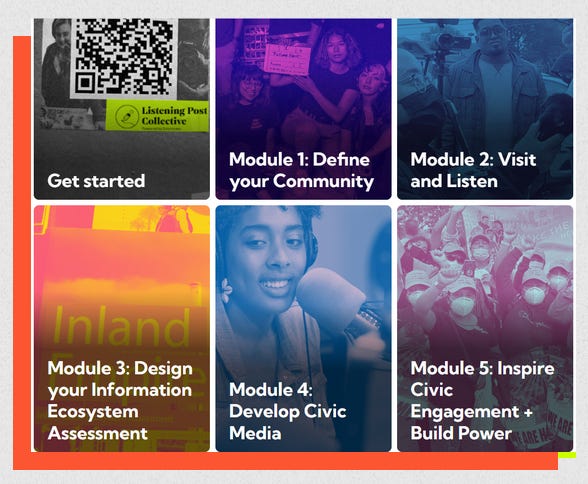
Jesse Hardman and I first met in Latin America nearly 20 years ago when we were both working as Knight Fellows training journalists and students — he in Peru, I in Bolivia. We became friends and have stayed in touch off and on over the years.
So it is with mixed emotions that I congratulate Jesse on the next step in his career. He has been accepted in the next class of John S. Knight Journalism Fellows at Stanford University. I am sure that he and his classmates will develop projects that help build trust in media.
Final thought
I’ve always said that bad journalism is a fantastically successful business. Just feed people’s appetites for entertaining, salacious, sensational, scandalous, or morbid news, and you can always find a ready audience. I admit it to reading and enjoying bad journalism — a guilty pleasure. Bad journalism will always attract lots of attention and advertisers.
Good journalism, on the other hand, takes time and money. If you want to get below the surface of what’s happening in the world, you have to hire skilled researchers and investigators and give them the time to find out what’s really going on. You have to follow the money and influence to see whether the powers that be are serving the public interest or using their power to enrich themselves at our expense.
So I am a paid subscriber, partner, friend, or financial supporter of a number of publications that practice the best public service journalism. In economic terms, journalism is a “public good” like public safety, public health, public education, and public transportation, among others.
In other words, journalism or public information — an essential pillar of a functioning democracy — cannot be provided by the market alone. If we want high quality trustworthy journalism, we need to support it.
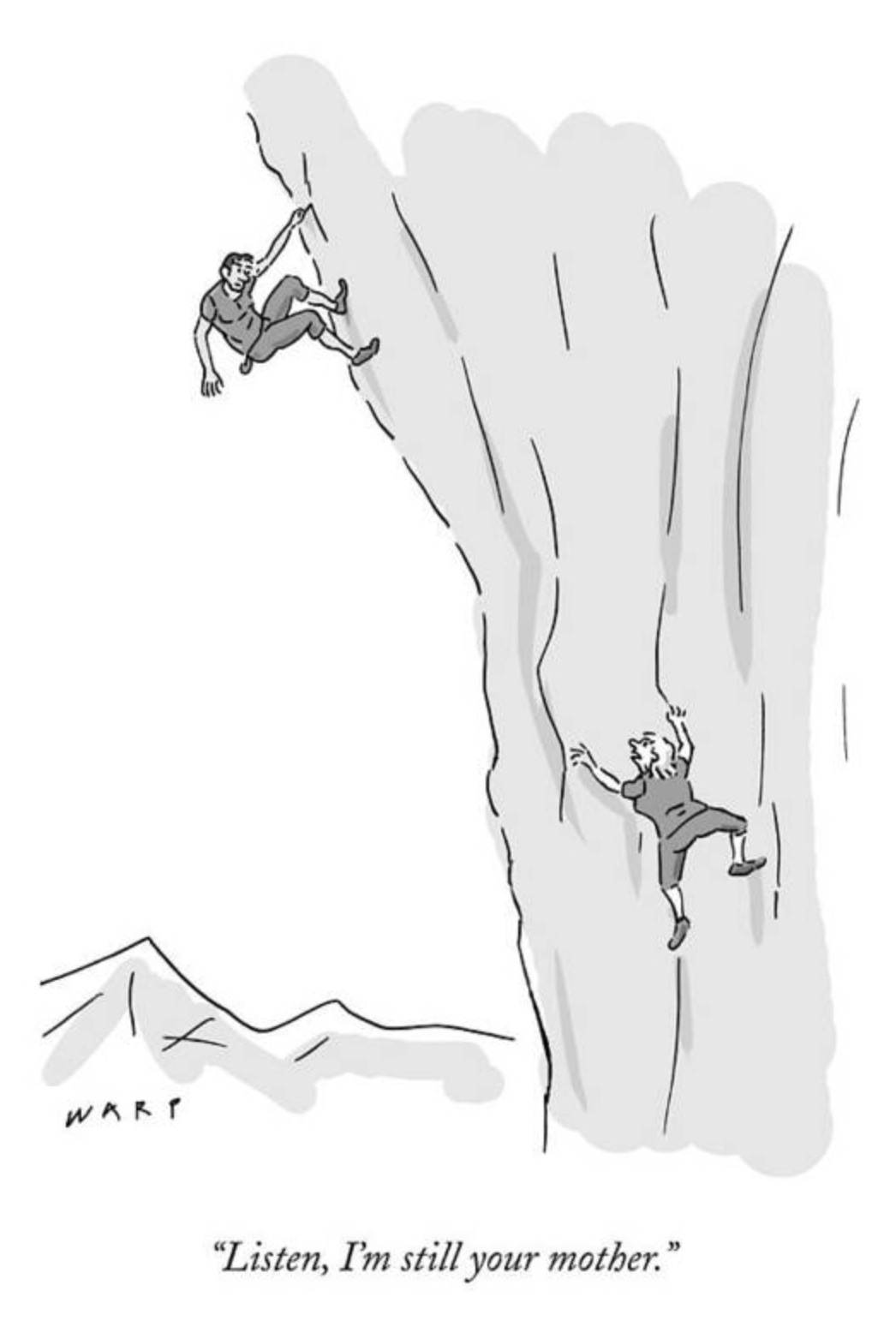
New Yorker cartoon by Kim Warp
Excellent post, James. I often find in your articles an insight that I can easily apply to my daily work. Best, Luis